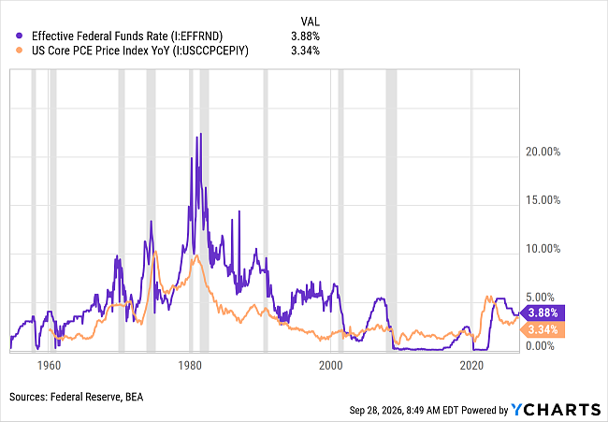
Core inflation, as measured by the Federal Reserve’s preferred Core PCE index, remains around 3.3% year-over-year as of July 2026 after surging above 5% in 2021. Outside of that pandemic-era spike, underlying inflation is still hovering near levels not seen since the early 1990s.
To cool prices, the Fed typically raises its overnight lending rate, increasing borrowing costs across the economy to ease upward price pressure. The recent rate hike into the 3.75% to 4.00% target range now puts short-term borrowing costs roughly 0.5% above the current rate of inflation.
History shows this balance can shift dramatically, as illustrated in the accompanying chart. During the persistent inflation of the 1970s and 1980s, the Fed often held rates more than 1% above inflation, while in the post-2008 era, policy rates sat consistently 1% below inflation. Today, the Fed faces a less predictable crossroads, though rising yields indicate the bond market expects rates may need to move higher to fully tame inflation.
. . .
U.S. equities finished last week modestly higher, although stock performance was only part of the story. Investors' attention remained focused on the bond market, where Treasury yields continued to climb as markets reassessed the outlook for economic growth, inflation, and Federal Reserve policy.
At the same time, incoming economic data continued to indicate that the U.S. economy remains on solid footing. That combination of steady growth and elevated inflation pressures has renewed debate around how long interest rates may need to remain restrictive.
Rising Treasury Yields Remained in Focus
The most significant development last week was the continued move higher in Treasury yields.
The yield on the 10-year U.S. Treasury rose above 5%, reaching its highest level since 2007, while longer-term Treasury yields approached levels not seen in more than two decades. Investors increasingly embraced the view that interest rates may stay elevated for longer than previously expected amid persistent inflation pressures, firm economic growth, higher energy costs, and the possibility of additional Federal Reserve tightening.
Importantly, yields were not rising solely because of inflation concerns. Investors also spent the week reevaluating the strength of the economy. Business activity surveys exceeded expectations, labor market conditions remained stable, and corporate spending tied to artificial intelligence infrastructure and broader technology investment continued to support growth.
Federal Reserve officials echoed that message throughout the week. Comments from policymakers suggested that additional rate increases remain possible if inflation progress stalls. Following the September FOMC meeting, investors continue to debate whether the most recent rate hike marked the conclusion of the tightening cycle or whether policymakers may need to take further action.
More broadly, bond markets appear to be adjusting to a landscape where interest rates remain higher not only because inflation remains above target, but because the economy has so far proven capable of absorbing tighter financial conditions. That represents a meaningful shift from the exceptionally low-rate environment that characterized much of the post-financial-crisis period.
Economic Data Continued to Support Growth
Economic releases during the week reinforced the view that activity remains healthy despite higher borrowing costs.
The latest purchasing managers' surveys showed stronger-than-expected conditions across both manufacturing and services.1 New orders improved, hiring trends remained constructive, and overall business activity reached some of its strongest readings in several years. Taken together, the data pointed to continued expansion across large portions of the economy.
Ordinarily, stronger economic growth would be viewed as a clear positive for financial markets. In the current environment, however, solid economic activity supports corporate earnings while also reinforcing expectations that the Federal Reserve may keep policy restrictive for longer.
Energy Markets Remained a Wild Card
Energy markets also remained an important variable for investors.
Oil prices were volatile as markets monitored developments involving Iran and the Strait of Hormuz, one of the world's most important energy shipping routes. Early in the week, renewed geopolitical tensions pushed crude prices higher and added to inflation concerns. Later reports suggesting potential diplomatic progress helped ease some of those concerns and contributed to a pullback in oil prices.
While crude oil finished below its recent highs, energy prices remain an important factor in the broader inflation outlook. Sustained increases in energy and transportation costs can eventually filter through to businesses and consumers, making the Federal Reserve's path back to its inflation target more challenging.
Our Perspective
One of the clearest messages from last week is that higher interest rates are increasingly being viewed as a reflection of economic resilience as much as inflation concerns.
The Federal Reserve remains focused on ensuring inflation continues to move toward its long-term target, and recent commentary suggests policymakers are not yet ready to declare victory. At the same time, economic activity has remained firm enough to support corporate earnings and overall market sentiment, even as financial conditions have tightened.
Periods like these often create short-term uncertainty as investors balance encouraging economic data against the prospect of higher interest rates. However, they can also create attractive opportunities, particularly within fixed income markets where yields remain at levels not available for many years. As we enter the fourth quarter, we remain focused on maintaining a disciplined, long-term approach while monitoring how economic growth, inflation, interest rates, and Federal Reserve policy continue to evolve.