Equity markets endured another volatile week, finishing lower as positive corporate earnings failed to alleviate concerns regarding the AI trade, and newly released economic data raised more questions for the Federal Reserve. However, markets rebounded on Friday, boosted by hopes of another interest rate cut.6 Market volatility is normal and often provides opportunities for lower entry points. The November pullback has been somewhat expected, given the magnitude and steadiness of the recent rally from April’s lows. 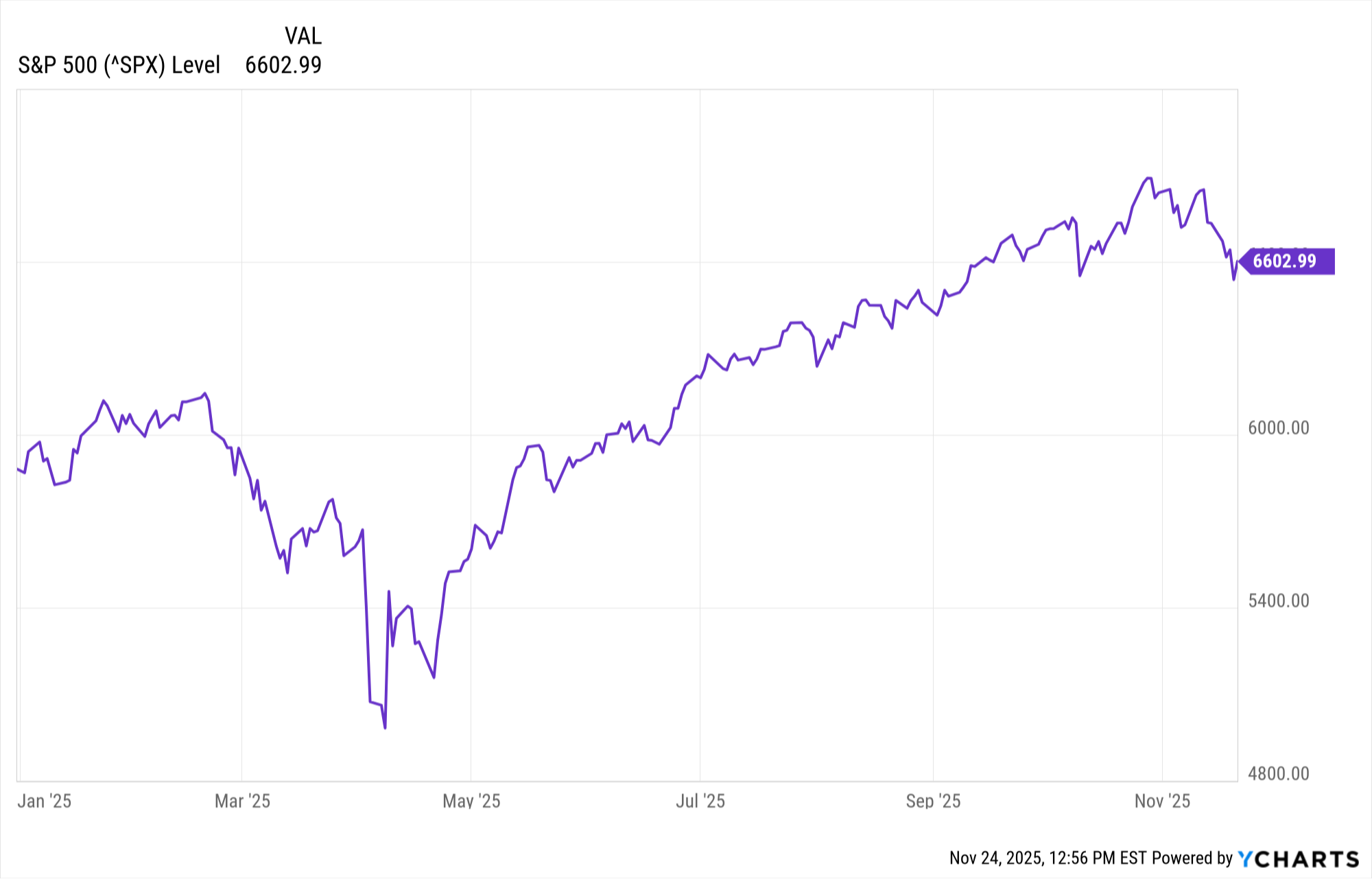
The U.S. equity market, as represented by the S&P 500, has rallied an impressive ~40% since its low point following the introduction of tariffs.7 Solidly supported by the Magnificent Seven (mega-cap tech companies), which have recently experienced a pullback as growing concerns regarding steep valuations and the long-term payoff from AI investments have risen. Nonetheless, corporate earnings results continue to show exceptional beats on revenue and earnings. For example, the much-anticipated Nvidia third-quarter earnings report was in the spotlight last week, showing stronger-than-expected results and confidence from CEO Jensen Huang, who revised guidance higher.8 The report was initially praised and contributed to a 1% rise in the S&P 500 and a 2% rise in the Nasdaq Composite. However, the reaction was shortly reversed as the results were not enough to ease concern over the sustainability of growth and valuations. Long-awaited economic data was also at the forefront of investors' attention, specifically the delayed September nonfarm payrolls report, which indicated a mixed labor market. Hiring rebounded with the economy adding substantially more jobs than anticipated; however, payrolls in July and August saw downward revisions, and the unemployment rate edged higher to 4.4% (the highest level since October 2021). The jobs report did little to help paint a clearer picture for the Federal Reserve. This is the last official labor market data the central bank will see before the next policy meeting. The October and November reports have been delayed until December 16, with only partial data being released due to the inability to collect necessary data during the government shutdown. Similarly, the Fed will not receive the October or November CPI (Consumer Price Index) report before the next policy meeting, as the October report has been canceled and the November release has been postponed until December 18th, after the Fed’s decision.9 Missing data has created a less-than-ideal scenario for the Fed. Minutes from the October meeting point to concerns from Fed members about “the ability to accurately assess economic conditions because of limitations to the availability of federal government data." Participants also noted, “against a backdrop of elevated inflation readings and a very gradual cooling of labor market conditions, further policy rate reductions could add to the risk of higher inflation becoming entrenched.” Under these circumstances, market expectations for an interest rate cut in December have fluctuated greatly. In late October, following the last decision, chances for another 25 basis point cut at the next meeting was nearly a guarantee with expectations measured at almost 100%. The odds slid to a low of 30% as of earlier this month and 42% as of early last week. Expectations changed again on Friday following commentary from New York Fed President John Williams. Williams announced that he sees “room for a further adjustment” on interest rates, raising market pricing to over a 70% chance of a cut, and contributed to a boost in equities.11 While a lower Fed Funds rate would likely be supportive of continued economic growth and corporate earnings, inflation remains higher than the Fed's own 2% target. With this in mind, we suspect the Fed’s target path for rates to be lower, but with a keen eye on new inflationary pressures. |