


Summary of Our Webinar Held on August 26, 2026
These days, we can pay the bills, order dinner, and catch up with loved ones without even leaving the kitchen table. This convenience is a real gift, and it calls for a little know-how. Online scams have grown sharply in recent years. Some target us directly, and others reach us through breaches of sensitive data held by large companies. Staying alert to these risks, and putting a few simple protections in place, goes a long way toward keeping your personal information safe.
On August 26, 2026, we hosted a webinar with our special guest, attorney Yael Rakib. Together we walked through the online risks we all face and the steps we can take to protect ourselves.
You can watch a full replay of the webinar below.
In this blog, we will discuss the following:
- The Scale of the Problem
- The Most Dangerous Schemes
- Red Flags and How to Avoid Them
- Estate Planning Protections
- Large Company Scams and Data Breaches
- What to Do if You Have Been Victimized
As we usually do, we opened the webinar with a few polls so attendees could share their own experience. The share of responses for each answer appears in parentheses.
Sign up for our email newsletter for views of the economy, stock market, and top news stories from our Wealth Managers at Financial Journey Partners.
Poll Question 1
How would you describe your confidence in your online security?
- I have processes in place that protect my personal information (24%)
- It could use some improvement (76%)
- I don't know what to do (0%)
Most attendees felt they had room to improve here.
Poll Question 2
Have you had a scammer get into your system?
- Yes (16%)
- No (42%)
- Almost (16%)
- I don't know (24%)
The answers reflected a wide range of experiences. We hope this recap helps you feel more secure online and better prepared to protect your personal information.
The Scale of the Problem
The losses from online fraud are large, and the number of victims keep growing. Older adults are among those most often affected.
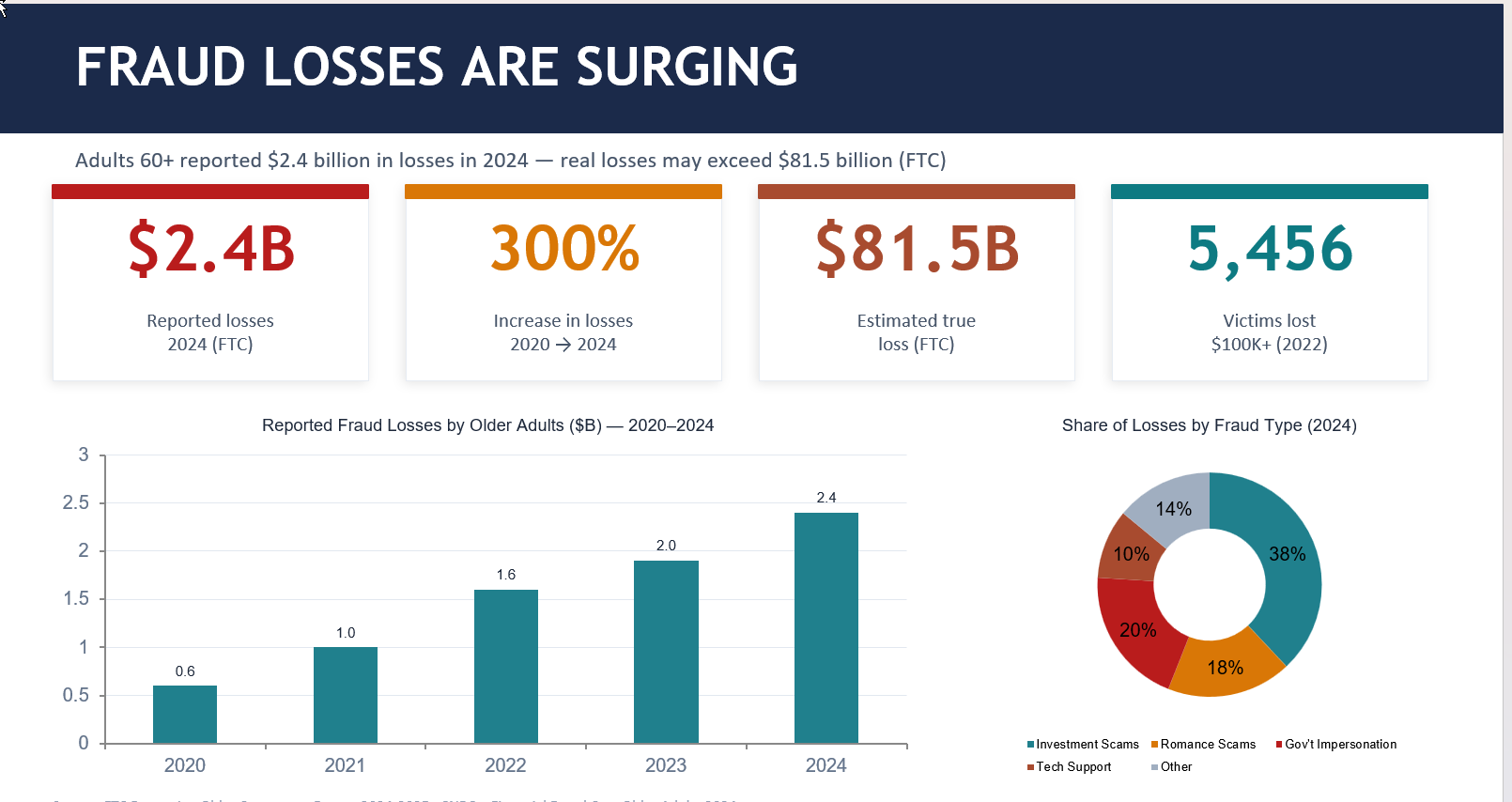
Sources: FTC Protecting Older Consumers Report 2024-2025, CNBC - Financial Fraud Cost Older Adults 2024
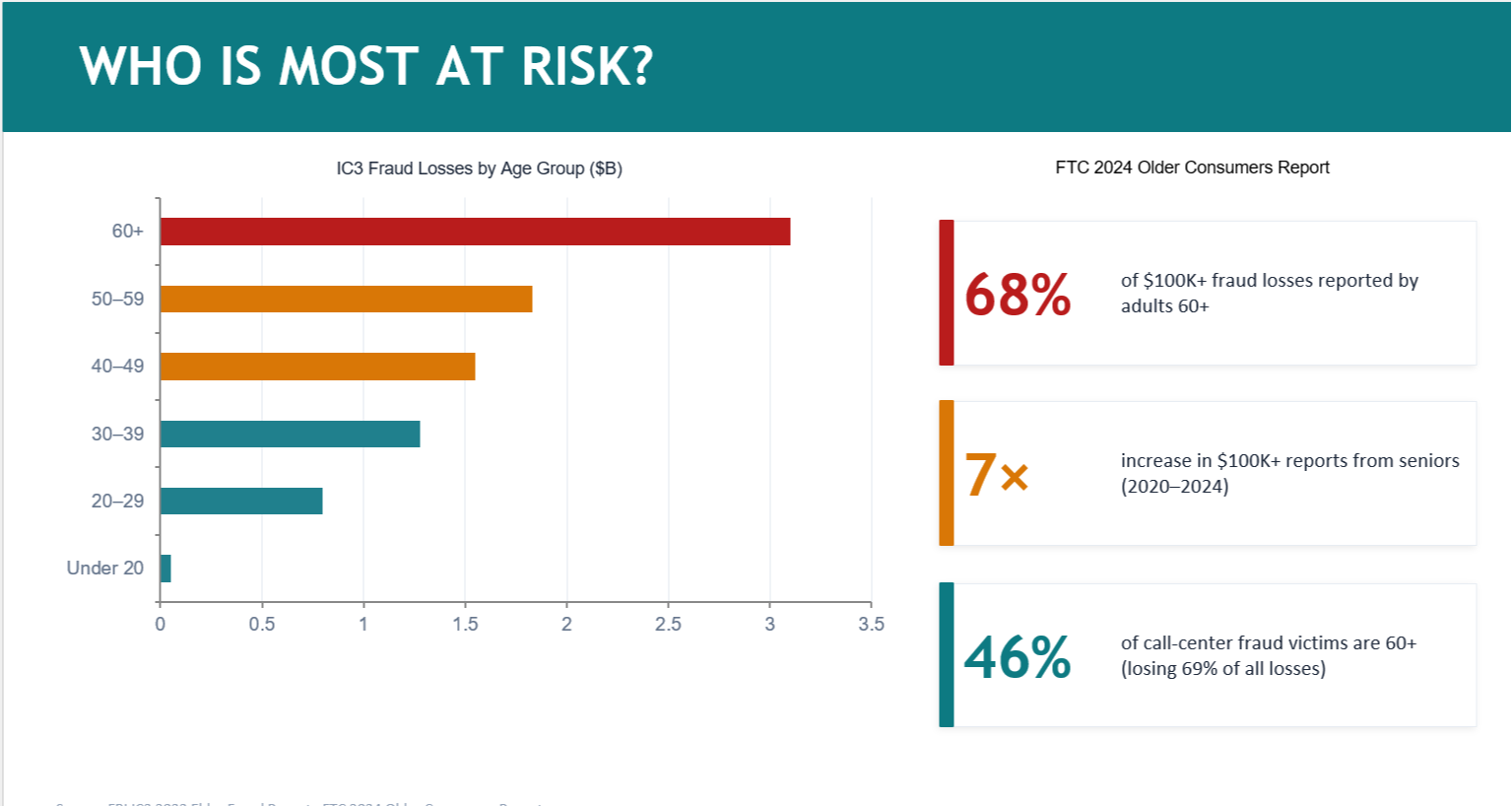
Sources: FBI IC3 3033 Elder Fraud Report, FTC 2024 Older Consumers Report
The Most Dangerous Schemes
Here are some of the most common and costly schemes.
Investment and Crypto Fraud
How it works
- Scammers build trust online through social media or dating apps
- They introduce a convincing but fake trading platform showing enormous gains
- Victims invest over time, but withdrawals are blocked once the balance grows large
- Crypto is the leading vehicle: $2.4B lost by adults 60 and older to crypto in 2024
Red Flags
- "Guaranteed" returns, when few investments are ever guaranteed
- Pressure to invest quickly or in secret
- Difficulty withdrawing your funds
Romance and Confidence Scams
The scheme
- The scammer creates a fake profile, often a widower, doctor, or military officer
- A relationship builds online over weeks or months before any money is requested
- Then comes an "emergency": a medical bill, a plane ticket, an investment opportunity
- $93M lost by adults 60 and older to romance scams, with losses still rising
Warning signs
- They never want to meet in person or on a video call
- They profess love very quickly
- There is always a crisis that requires financial help
Tech Support Scams
- A pop-up warns that your computer is infected and tells you to call Microsoft now
- The scammer gains remote access, "finds" malware, and charges hundreds of dollars
- $159M lost in 2024 by older adults to tech support scams (FTC)
Government Impersonation
- "Your Social Security number has been suspended": pay now or face arrest
- Callers claim to be the IRS, Medicare, the FBI, or local law enforcement
- $789M lost to government imposter scams in 2024 (FTC)
- Payment is demanded by wire transfer or gift card, never legitimate methods
Will, Trust, and Estate Fraud
- Undue influence: a caregiver or family member pressures changes to a will or trust
- Forged signatures on estate documents
- Sudden revisions to an estate plan after someone is isolated from family
- A trustee or executor misappropriating funds
- Unauthorized joint owners added to financial accounts
Grandparent and Family Scams
- "Grandma, I'm in jail, please send bail money, and don't tell Mom"
- AI cloned voices now mimic a real grandchild's voice
- $3.8M lost by adults 60 and older to grandparent scams
Lottery and Sweepstakes Fraud
- "You've won $2M, just pay $500 to release your prize"
- More than $70M lost by adults 60 and older to lottery scams
- Taxes, processing fees, and legal costs are demanded up front
- No real prize ever arrives
Home Title Theft
- Criminals forge your signature to transfer your home's title without your knowledge
Fake Profiles and Phishing Invitations
- A scammer clones a friend's social media account and sends a "party invitation" that looks real
- Clicking the link takes you to a fake login page, or quietly installs a remote access tool on your computer
The Jury Duty Panic Scam
- A caller claims to be a sheriff's deputy or U.S. Marshal and gives a fake warrant number
- You are told you cannot tell family or friends without facing charges
These are only some of the more common schemes, and new ones appear all the time. It pays to stay alert.
Red Flags and How to Avoid Them
Here are some of the most common warning signs. If you notice one, stop before you act.
- You are pressured to act immediately or in secret
- Payment is requested in gift cards, wire transfer, or cryptocurrency
- Contact you did not ask for: a phone call, email, text, or pop-up
- Guaranteed returns or no-risk investment offers
- A request for remote access to your computer
- Anyone asking you to move money to “protect” it
- A government agency threatens arrest unless you pay right away
- Someone you have never met is asking for money
- Unexpected requests from family members through unfamiliar numbers
- You are asked to keep the transaction secret from your family
If a message feels wrong, it probably is. Stop, and check with a family member or friend before you do anything.
Estate Planning Protections
A few habits can protect you against estate planning schemes.
- Vigilance: stay informed on common fraud schemes so you can spot and avoid them
- Credit freezing and monitoring: place a freeze at all three bureaus, which prevents new accounts from being opened in your name. You can also sign up for monitoring through a service.
- See something, say something: if something does not feel right, reach out to family, friends, or a trusted advisor first
- Trusted contact designation: authorize your financial advisor and attorney to contact a family member if fraud is suspected
Large Company Scams and Data Breaches
Even the largest companies and government agencies are not immune. Recent years have brought data breaches at Kaiser Permanente (2024), Carnival Corporation (2026), and Instagram (2026). Scammers also borrow trusted names to seem legitimate, and this year the following organizations warned that their names were being used to target their customers:
- Fidelity: customers are told they owe an overdue remittance
- PG&E: the utility warned customers that scammers were using its name, often demanding payment of utility bills in unusual ways such as debit cards and gift cards
- Medicare: scammers try to obtain your Medicare information so they can bill Medicare for services you never receive
- Wells Fargo: imposters contact customers claiming it is urgent that they call back immediately
- American Airlines cardholders: the airline has warned holders of its credit card to be wary of online shopping fraud using their cards
These are only a few of the companies whose customers have been targeted this way.
What to Do if You Have Been Victimized
If you think you have been caught by an online cam, act quickly.
- Stop all contact and payments-- Do not respond to further calls or messages, and do not send more money, even if you are told you will lose what you have already paid
- Contact your bank immediately -- Ask for a freeze or a wire recall. Banks can sometimes reverse recent wire transfers within 24 to 72 hours
- File a police report-- Get a case number, which many insurance claims and legal steps require. Contact your local police department and the FBI
- Report to federal agencies -- Report to the FTC at REportFraud.ftc.gov and to the FBI's IC3 at IC3.gov. If you are 65 or older, also report to Adult Protective Services
- Consult an attorney -- Civil remedies can include restitution, restraining orders, and challenges to a trust or will. Time limits apply
Many of the points above are gathered in a two-page guide you can download for reference. We suggest printing it and keeping it near your computer.
DOWNOLAD THE SCAM DEFENSE GUIDE 2026
Your Wealth Manager is here to help in any way we can. If someone contacts you and you are not sure what to do next, call us, and we will do our best to help.
If you have questions about the economy, the stock market or your portfolio, please call your Wealth Manager, Elaine Manley, Scott Manley, Linda Tjiputra, are always glad to talk it all through with you.

The information being provided is strictly as a courtesy. When you link to any of the websites provided here, you are leaving this website. We make no representation as to the completeness or accuracy of information provided at these websites. Nor is the company liable for any direct or indirect technical or system issues or any consequences arising out of your access to or your use of third-party technologies, websites, information, and programs made available through this website. When you access one of these websites, you are leaving our website and assume total responsibility and risk for your use of the websites you are linking to.
Investment advisory services offered through Mutual Advisors, LLC DBA Financial Journey Partners, an SEC Registered Investment Adviser. Securities offered through Mutual Securities, Inc., Member FINRA/SIPC. Mutual Securities, Inc. and Mutual Advisors, LLC are affiliated companies.